GPT-6-Astra Edits a VLA Policy Directly
The University of Hong Kong
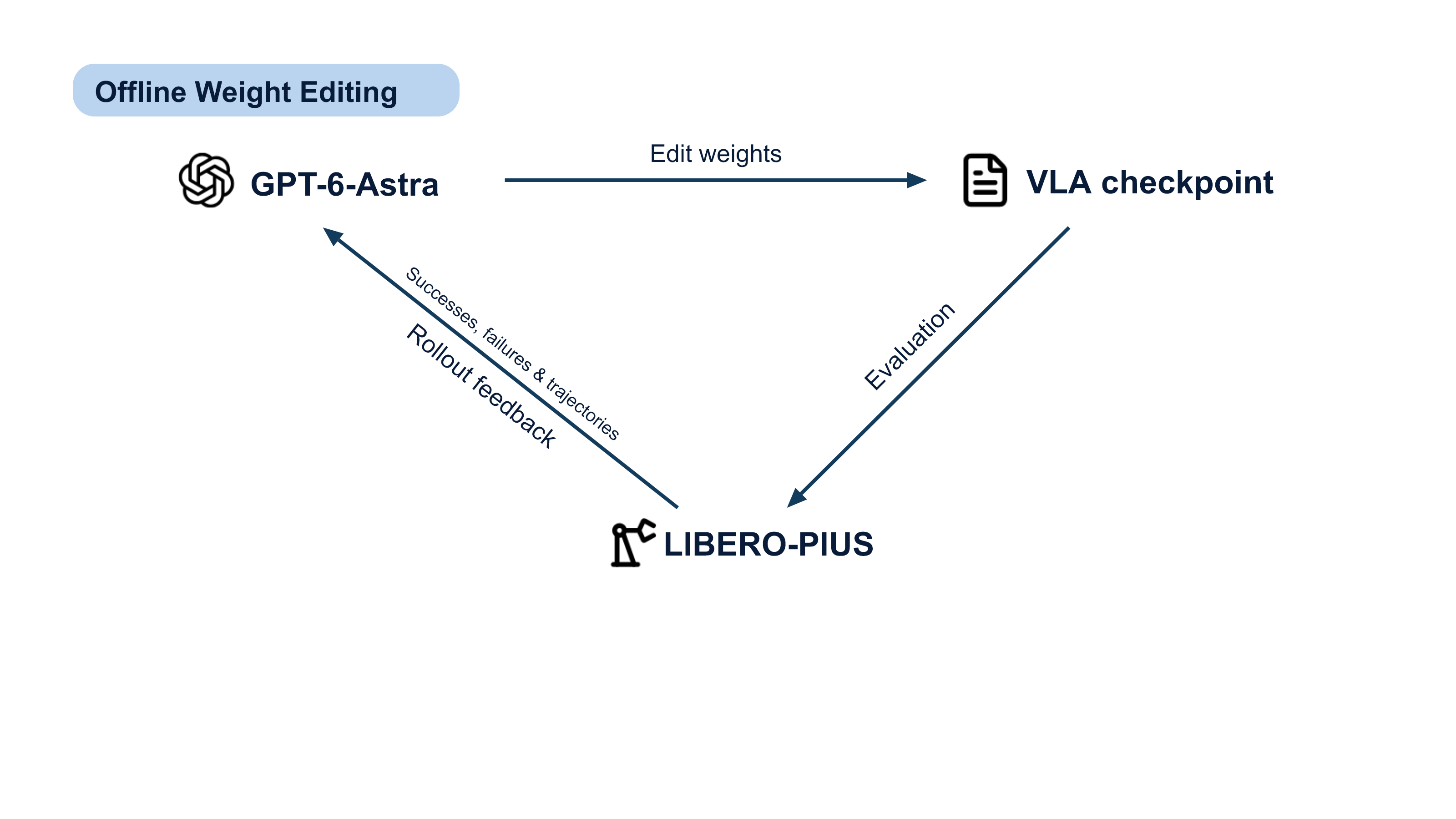
We downloaded a VLA checkpoint trained on the LIBERO benchmark and selected the task “Put both moka pots on the stove” under a lighting perturbation from the Light Conditions category of LIBERO-PLUS. The original checkpoint achieved a Success Rate (SR) of 3/50 (6%). We then gave GPT-6-Astra access to all parameters of the checkpoint and provided it with the results of each experiment, including both successful and failed trials. GPT-6-Astra iteratively edited the weights without gradient-based training. After 25 rounds, the edited policy achieved an SR of 18/50 (36%)—an improvement of 30 percentage points.
We give GPT-6-Astra access to all model parameters and a simulator evaluation interface. It can inspect weights and analyze successful and failed trials after each round, along with execution trajectories and robot state records, to decide which parameters to edit next and by how much. The experiment follows a cycle of proposing edits, running evaluations, and analyzing feedback. After completing the editing rounds, we evaluate the edited VLA checkpoint over 50 trials. The process uses no gradient-based training, but it remains an optimization procedure driven by experimental feedback. The weights remain fixed throughout evaluation.
Weight edits and transfer performance
Compared with the original VLA checkpoint, the edited version contains 76,858,078 modified parameter values, representing 1.71% of the model’s parameters, across 27 tensors. The modifications mainly affect the MLPs in language layers 34–35 and visual blocks 18–23.
The language edits attenuate a selected MLP output direction with coefficients of 0.50 and 0.55. In the final round, GPT-6-Astra scales the first-layer weights and biases of six visual MLPs by 0.5 and their second-layer weights by 2.0, leaving the second-layer biases unchanged. These factors apply to the checkpoint entering that round. Because GELU is nonlinear, the two scalings do not simply cancel. The improvement in SR reflects the accumulated edits and cannot be attributed solely to the final visual adjustment.
We then evaluated the fixed edited checkpoint on nine additional LIBERO-PLUS lighting tasks whose results had not been used to guide editing or checkpoint selection, with 50 trials per task. Compared with the original VLA checkpoint, SR decreased from 96.67% (435/450) to 88.22% (397/450). Performance declined on five tasks, remained unchanged on three, and improved on one.
These results suggest that the edits adapt the policy to the task supplying feedback, without producing a broad improvement across tasks. A plausible explanation is that changes to shared representations favor behaviors useful for the target task while disrupting behaviors required elsewhere. In robot control, even a small action change can alter subsequent observations and the rest of the trajectory. The current evidence therefore supports task-specific improvement accompanied by performance losses on other tasks, rather than a general increase in robustness. Separate tests of the visual and language modifications are needed to understand their contributions.
| Round | 0 | 5 | 10 | 15 | 20 | 25 |
|---|---|---|---|---|---|---|
| Edited Parameters (%) | 0% | 0.3280% | 0.5794% | 0.5883% | 1.1473% | 1.7067% |
| SR | 3/50 (6%) | 6/50 (12%) | 14/50 (28%) | 14/50 (28%) | 16/50 (32%) | 18/50 (36%) |
Acknowledgments
We thank the teams behind Sparks of Weight-Space Programming, StarVLA, and LIBERO-Plus for these excellent projects.