Overview
CleanRUA classifies robot-use agents by two questions: what does the MLLM send each turn, and what turns it into robot motion. The answers decide the shape of the interaction loop, so each paradigm is one algorithm and one file.
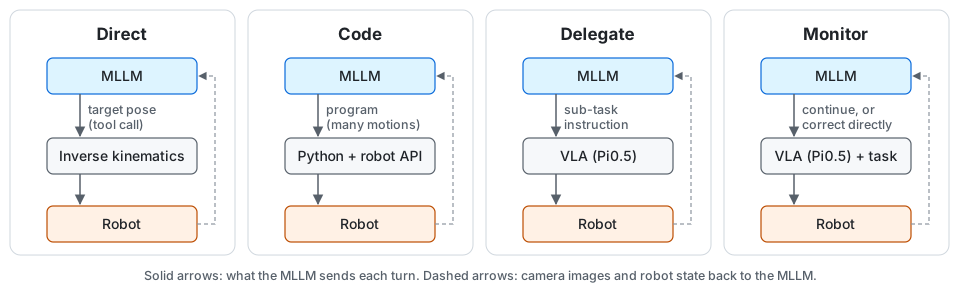
| Algorithm | The MLLM sends | Motion comes from | Based on |
|---|---|---|---|
| Direct | One motion tool call, such as a target pose | Inverse kinematics | uni-robot-agent Clean mode; GPT-6 Astra on RoboDojo |
| Code | A Python program | A robot API called by the program | Code as Policies; CaP-X |
| Delegate | A sub-task instruction for a VLA | Pi0.5 | uni-robot-agent hybrid mode; Hi Robot |
| Monitor | "Continue", or a correction | Pi0.5 with the task instruction, and the MLLM's motion tools | Spotter; GPT 6 Astra as an Embodied Policy |
A variant changes one aspect of a paradigm and adds a word to its file name, so each file still implements one
algorithm: code_delegate lets Code programs call the VLA, and code_jev and direct_jev compact the history
with Jev. Cross-episode learning, such as playbooks, memories and skill libraries, will be added the same way, for
example direct_memory_robodojo.py.
What every agent shares
Each agent file has the same layout, top to bottom:
Args: every hyperparameter, parsed with tyro.--helplists them.RoboDojoWrapper: agym.Wrapperthat turns the joint-level environment into a tool-calling one. Tools are@Toolmethods: the signature becomes the argument schema and the docstring the description shown to the model. A tool runs as a generator of joint-level actions, andstep()executes them one by one withfor motion in self.parse_action(action)().SYSTEM_PROMPT: the robot conventions and the paradigm's rules.RUAgent: the policy. It sends the current images and state to the model and returns one tool call.- The main loop: reset, ask the agent, step the environment, log, and finally record the environment's verdict.
The interaction itself follows the Gymnasium API: the action is {'name': tool, 'arguments': JSON}, and the
observation is the environment observation plus feedback, a JSON string describing how the tool call went. A tool
that raises ValueError returns the error as feedback instead of crashing.
Defaults shared by all agents:
| Setting | Default |
|---|---|
| Context | System prompt, task text, the last 4 tool calls with their results (text only), and the current observation with all three camera images |
| Task text | The native instruction, per-task requirements from uni-robot-agent (for example returning the arms), and the initial grasp-site poses |
| Budgets | 60 decisions, 1,000,000 tokens and 1,800 seconds per episode |
| Model API | Chat Completions with tool_choice=required, one tool call per turn and stream=False |
Logged outputs
Each run writes to runs/<task>__<exp_name>__<seed>__<time>/:
| Output | Content |
|---|---|
result.json |
Stop reason, official success and score, decisions, tokens, total reward and elapsed time |
trajectory.jsonl |
Every model reply, tool call, feedback and arm state |
images/ |
The camera images shown to the model at each decision |
videos/ |
All three cameras side by side, when --capture-video is on |
| TensorBoard | charts/total_tokens, reward, native_steps, tool_ok, success and score |
finish only ends the episode. Success and score always come from the environment's own check, which the agent
never sees.